Rotating assembly test rig
A rig built to characterise stepper motor speed-torque behaviour — voltage, current, and microstepping configuration all move the curve far more than the single reference plot most datasheets publish suggests.
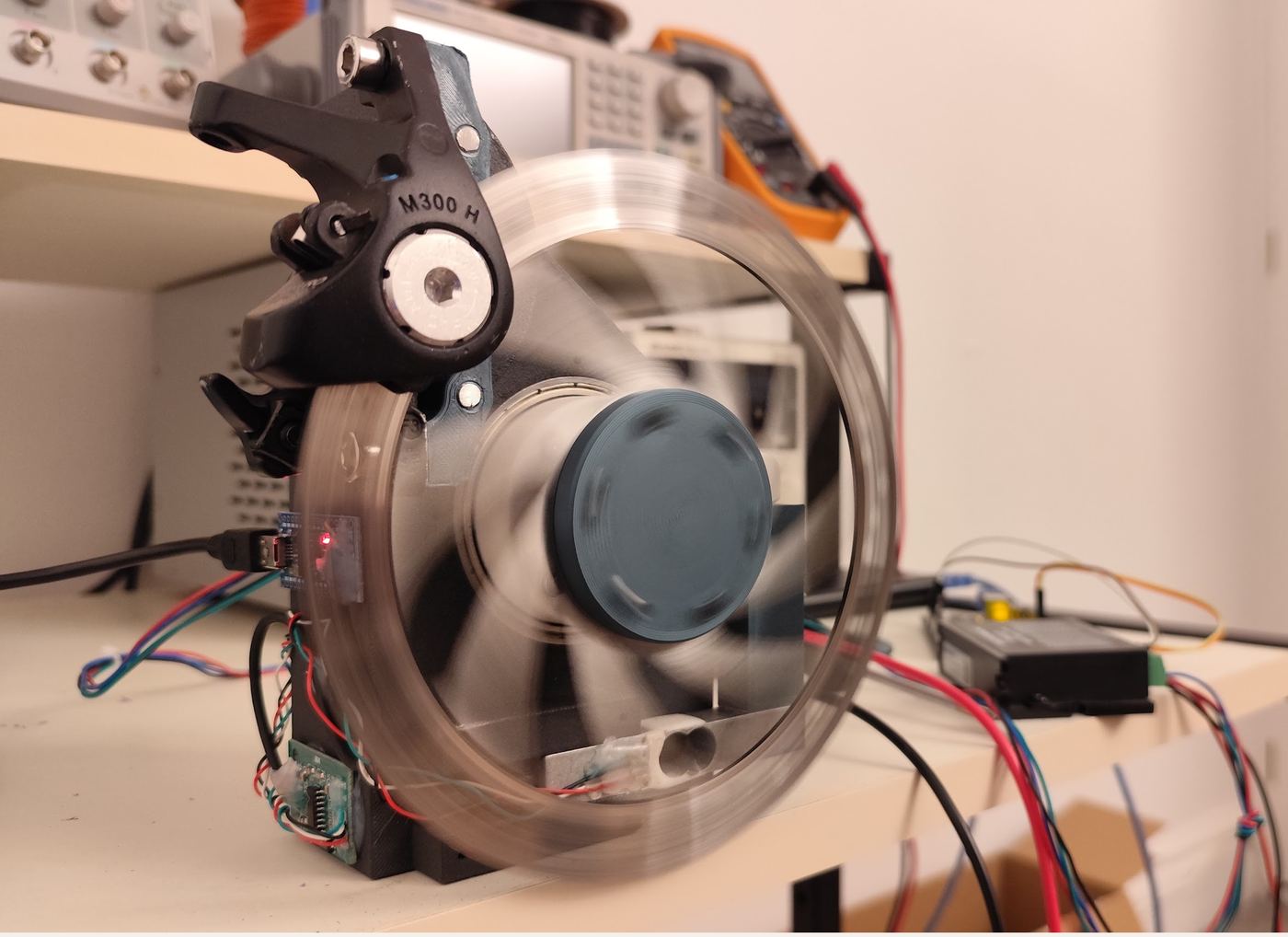
Motor datasheets tend to give, at best, a single reference speed-torque curve — not much use once supply voltage, current setpoint, or microstepping configuration start moving away from that one reference point. This rig measures it properly: a NEMA17 motor sits on a rotating mount constrained by a load cell, with a bicycle brake disc and caliper providing a controllable load. Measuring the reaction torque on the stationary mount sidesteps the slip rings or wireless telemetry that measuring in the rotating frame would otherwise need.
Built from FDM-printed parts, a hobby-grade strain gauge, and an Arduino Nano, it reproduced a motor's datasheet curve almost exactly under the same reference conditions — a good sign the measurement approach itself is sound. The brake caliper turned out to be a fairly blunt instrument, closer to on/off than proportional, which is arguably what you'd expect trying to modulate bicycle braking hardware against a NEMA17's torque — but it was enough to get useful preliminary results. Motorising the braking system, to run automated sweeps across a wide range of conditions and drivers, is the planned next step.
The real interest behind the rig is a gap most people don't test: how small steppers behave at higher-than-normal supply voltages. Steppers have a reputation for being a poor choice at both high speed and high efficiency, but that reputation softens considerably in applications — like small robotics — where low duty cycle and low absolute power draw make a modest efficiency hit easy to live with. Driven by a good sine-wave driver, a stepper isn't so different in principle from a very high pole-count BLDC or AC servo, and the 300–1000rpm range in between the two motor types' classical operating regions is genuinely useful for robotics: low enough reduction to keep efficiency high, backlash low, and noise down, without needing a direct-drive stepper large enough to deliver the torque outright.
Almost nobody runs small steppers — say, a NEMA17 on a 72V rail — at these higher voltages, likely in part because low-current, high-voltage drivers for that scale of motor are hard to find, and the lack of demand for them probably doesn't help supply. This rig exists to actually characterise that region, and find out whether there's a good reason nobody's using it, or whether it's simply been overlooked.